
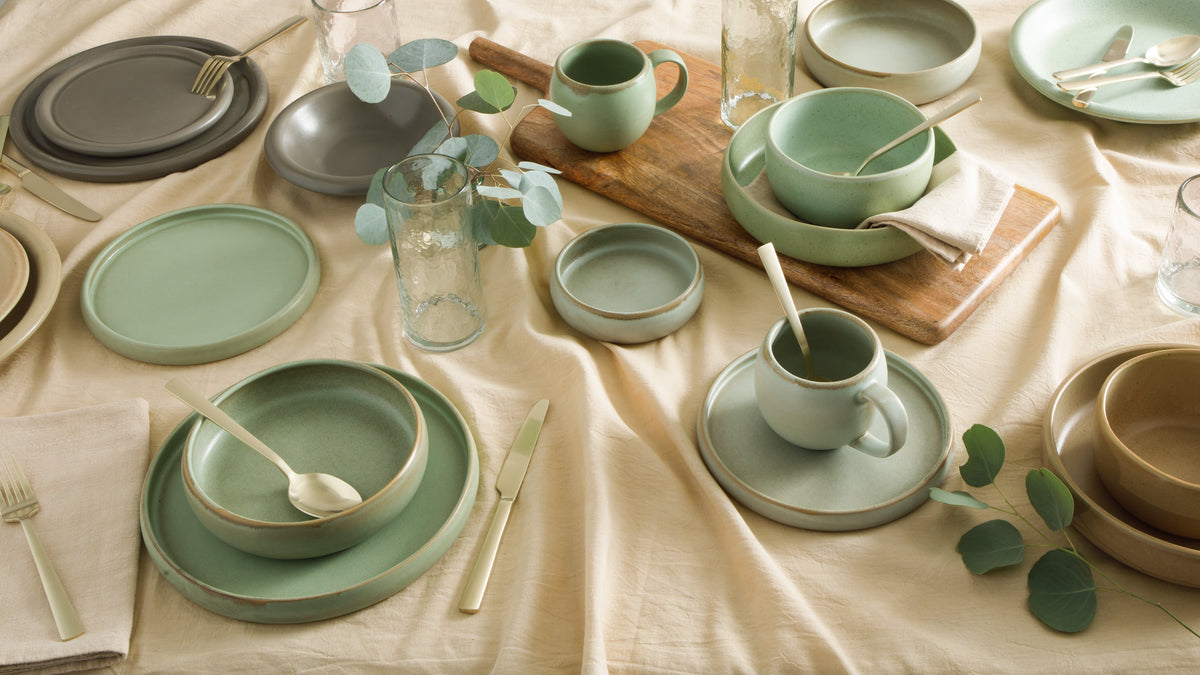
The material behind your dishes shapes your dining experience more than you might think. It decides how a piece feels in your hands, how it holds up on a busy weeknight, and how it looks when the table is set for a crowd. Here's what sets each dinnerware material apart, so you can choose plates that fit you actually eat and gather.
Porcelain
LUMINOUS, REFINED, QUIETLY SPECIAL
Porcelain begins with kaolin, a pure white clay, blended with feldspar and quartz. It's fired at some of the highest temperatures in ceramics, around 2,350° to 2,400°F, until the clay vitrifies: its particles fuse into a dense, glass-like body that stays non-porous even beneath the glaze.
That density is where porcelain gets its character. A clean, bright white. A soft glow when you hold it up to the light. A clear ring when it's tapped. It can be thin and elegant without feeling fragile, and its smooth surface makes cleanup easy.
You'll often hear porcelain called fine china. It also has two close relatives worth knowing: bone china and new bone china.

In this photo: Gibson Home Ogalla 30-piece Porcelain Dinnerware Set
Bone China
STRONG, TRANSLUCENT, HEIRLOOM-WORTHY
Bone china starts with the same fine porcelain ingredients, then adds one more: bone ash. Traditionally, it makes up 30 percent or more of the clay body, and it changes everything about how the finished piece looks and feels.
Bone china is fired twice, first at around 2,200°F to set its shape and then again at a lower temperature to set the glaze. The result is remarkably thin and light, with a soft, milky white and a translucency you can see when you hold a plate up to the window.
Bone china is surprisingly strong for how thin it is. It's the material behind many heirloom sets, the kind that come out for holidays and get passed down, though plenty of people love using it every day.

In the photo: Gibson Elite Embossed Bone China 16-piece Dinnerware Set
New Bone China
MODERN, BRIGHT, REFINED
New bone china borrows the name sans the bone ash. Most versions skip bone ash entirely and use a blend of refined clays, feldspar and minerals instead. The goal is the same bright, smooth, lightweight feel, in a durable form made for daily meals. Every manufacturer has its own recipe, so there's more variety from one brand to the next than with traditional bone china.
Stoneware
STURDY, GROUNDED, MADE FOR EVERY DAY
Stoneware is named for what it becomes in the kiln: dense, durable and stone-like. Fired at 2,250° to 2,350°F, just below porcelain, it has a heavier, more substantial feel and an easy, rustic warmth.
The natural minerals in stoneware clay often give it a warm, oatmeal-toned body that shows at the rim or the foot. Modern glazes also make crisp white stoneware possible, for anyone drawn to a pared-back, quietly elevated table.
This is the set you'll reach for at breakfast and again at dinner. Its thick walls and dense body are made to hold up to daily use, whether it's finished in earthy neutrals or bold, saturated color.

In the photo: Gibson Elite Malibu Shore 16-piece Stoneware Dinnerware Set
Terracotta
EARTHY, SUN-WARMED, TIMELESS
Terracotta means “baked earth” in Italian, and that's exactly what it is. A type of earthenware made from iron-rich clay, it's fired at low temperatures to bring out its signature reddish-brown color. Often left partly unglazed, it has an organic, matte texture that makes even a simple dish look like it belongs at a long lunch outdoors.

In the photo: bloomhouse® Santorini Mist 16-piece Stackable Terracotta Dinnerware Set
Tempered Opal Glass
LIGHT, BRIGHT, READY FOR ANYTHING
Opal glass has the clean, milky-white look of porcelain with the practical perks of glass. It's tempered, a heat-treating process that makes it much stronger than ordinary glass and built to resist the everyday chips and knocks of a busy kitchen.
Its smooth, non-porous surface resists stains and wipes clean easily, so it stays bright wash after wash. Lightweight and easy to stack, it's made for full households, family dinners and every day in between.

In the photo: Martha Stewart Opalton 18-piece Opal Glass Dinnerware Set
Finding Your Match
There's no single right answer, only the one that fits how you live. Reach for porcelain when you want pieces that feel special. Bone china for heirloom-worthy elegance. New bone china for everyday polish. Stoneware for sturdy, everyday warmth. Terracotta for earthy character. And tempered opal glass for light, easy-care pieces that are ready for anything.
Outfit your table according to your style. Don't be afraid to mix. A stoneware dinner plate under a porcelain salad plate, a terracotta bowl passed down the table. The best tables are the ones that feel like yours.