
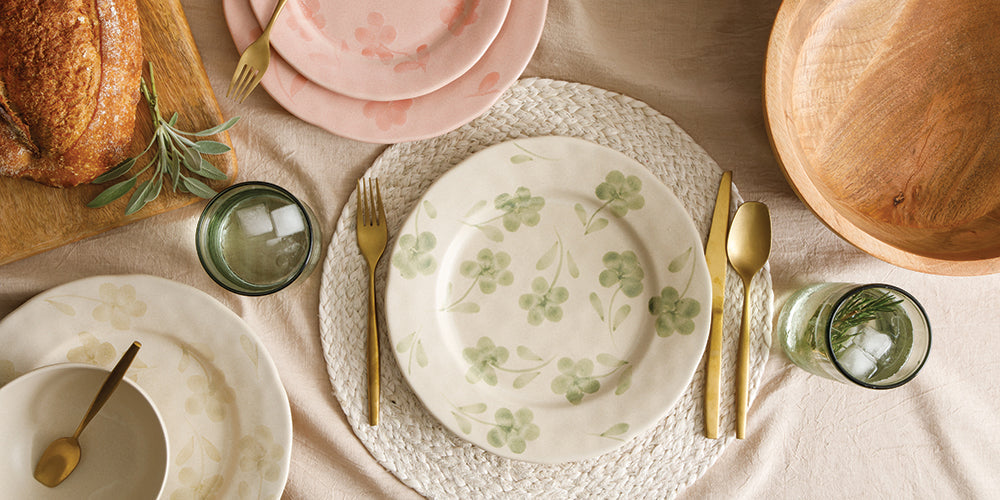
If you’ve ever walked into a home goods store and felt overwhelmed by all the different types of plates, bowls, and bakeware, you’re not alone! Whether you're looking to set up your kitchen, start baking, or host your first dinner party, understanding the basics can make a huge difference. We’ve listed the key terms related to ceramics, dinnerware and anything about the centuries-old tradition of pottery-making so you can feel confident in picking the right pieces for you and your home.
Bisque (or Bisquit) – Clayware that has been fired once for hardening but has not yet been glazed.
Bisque Fire – The first firing, or baking, in clayware manufacture, which hardens the ware into its final shape.
Body – The physical composition of a piece of clayware as opposed to its glaze or decoration. Types of body are clay, dolomite, earthenware, stonelite, stoneware, porcelain and bone china.
Bone China – A type of porcelain that contains animal bone ash for added strength, translucency, and whiteness. 
Bright gold - a liquid gold paint decoration which, when fired, comes out bright and therefore requires no burnishing or polishing.
Casting – A process where liquid clay (slip) is poured into a mold and allowed to set, creating a shape.
Casual china: a non-porous type of clayware made of special white clay and fired at exceptionally high temperatures. The finer grades are generally thin, translucent, resistant to chipping, and ring clearly when struck. The word should not be used as a generic term for all dinnerware.
Ceramics – A broad term for items made from clay and other natural materials, then hardened by heat.
Clay – The essential raw material for ceramics, formed from weathered rock and minerals.
Coupe shape: a contemporary plate shape lacking a shoulder, like an inverted Frisbee, flat across the diameter and rolled up slightly at the rim.
Crackled ware: clayware whose surface is marked by a network of tiny cracks deliberately induced for decorative effect by sudden cooling.
Crazing: a defect in clayware glaze consisting of a network of tiny cracks caused by the difference in the rate of contraction between body and glaze. It is almost the same in appearance as deliberate cracking.
Decal: a special design-bearing sheet used in dinnerware decoration. The paper is then removed resulting in the transfer of the decoration to the ware. Subsequent firing makes it permanent.
Earthenware – A type of pottery fired at lower temperatures, making it more porous and delicate.
Embossing – Raised or molded designs on pottery, either made in the mold or applied separately before firing.
Feldspar: a common mineral used in some china and glazed materials.
Filling-in: a decoration process whereby transfer print outlines applied to a piece are filled in by hand to produce multi-colored effects.
Firing – The process of baking ceramics at high temperatures to harden and strengthen them.

Fine china: thin and translucent, it is quite strong despite its delicacy. It is made of top-quality clays fired at high temperatures that cause them to fuse into a hard, non-porous body.
Glaze – A glossy or matte coating applied to pottery to add color and make it waterproof.
Hand-Painted – Designs applied by hand rather than printed, making each piece unique.
Hollowware: any clayware pieces, such as cups, pitchers, of bowls that have three-dimensional properties, as opposed to flatware.
Ironstone – a much-misused term that should be used only in reference to earthenware of good quality and better-than-average strength. True ironstone was originally developed in England. Originally it was a form of stoneware said to contain powdered iron slag. Ironstone has a slightly porous body.
Jiggering: jigger machine used to make mugs. A rotating system is used to form the clay into the shape of the mold.
Kiln – A special oven used to fire pottery at high temperatures.